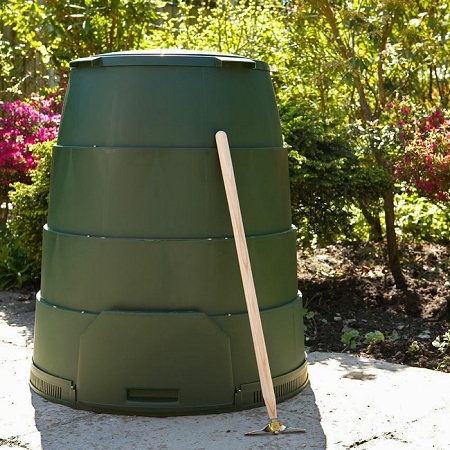
The Green Johanna
Composter offers a new composting alternative
The Green Johanna Composter was developed to provide a simple,
easy to use compost system to safely compost all degradable kitchen
waste all year round! The patented design of Green Johanna Composter
means you do not have to know much
about composting. Everyone can compost with the Green Johanna
Composter! This system can compost two parts food waste to one part
garden waste. All food waste including meat, fish and bones can be put
in Green Johanna Composter.
Food
Waste Composting : :
To fully appreciate the Green Johanna Composter’s design it helps to
consider what is necessary to recycle waste the way nature does. Every
year the same natural cycle occurs; leaves, twigs and trees fall to
earth, decompose and become food for new plants.
Naturally occurring microorganisms, bugs and worms, together with
oxygen and moisture do all the work. In the process heat is produced.
These incredible microorganisms work at temperatures as high as 150°F!
This type of composting is known as ”hot” composting, and oxygen in the
air is critical to the process.
Why Make Compost?
More than half of our “garbage” is biodegradable and can be
composted. The nutrients that we take from the earth are now primarily
replaced with petroleum-based fertilizers, which are expensive to
manufacture, likely harmful to people, animals, plants and insects, and
contribute to worldwide political and social instability. By contrast,
natural nutrients, found right in our trash bins, can be easily
converted into superior fertilizers without causing social, political
or physical harm to anyone.
Despite the gloomy figures about how much waste we produce, the future
is looking brighter. More and more people are starting to make compost,
and finding meaning and fulfillment in turning their “garbage” into
nutritious rich compost. When we begin to compost, we participate in
the natural cycle and order of things. We also tend to become more
conscious about what we buy, use and throw away.
 Sorting
at the Source Begins in the Kitchen: Sorting
at the Source Begins in the Kitchen:
The kitchen is where you must begin
separating the glass, plastic and metal from the material which can be
composted. Simply add another bin in your kitchen and separate the
waste that can be composted from that which cannot. Though, we
recommend you explore the many benefits of a vegan diet, all food waste
can be composted: vegetables, fruit, dairy products, bread, bones, fish
remains, soup and eggshells. Coffee filters containing coffee grounds,
tea bags, household paper, egg cartons, and wilted flowers and
houseplants can also be added to the compost. Grass clippings, leaves,
twigs, weeds, bark, etc. can also be composted. It is recommended to
cut the waste into small pieces, as this gives the microorganisms more
surface area to work on, producing compost more quickly!
Stirring
Stick:
A stirring stick is an accessory item
(NOT INCLUDED with the Green Johanna) that helps
you aerate the compost effectively. It is made of wood and has two
movable metal blades at one end. Some stirring sticks have point metal
"fingers". Either kind will work perfectly. A Compost Stirring Stick may
be purchased at many hardware stores and plant nurseries.
This is No
Ordinary Compost System!
·
The Green Johanna Composter allows you to
compost all your food waste. This means bones, bread, dairy, eggshell,
fish, fruit, meat, soup and vegetables can all be used and composted,
as well as coffee filters, teabags, household papers, egg cartons,
wilted flowers and dead houseplants.
·
The Green Johanna Composter allows you to
make compost all the year round. No matter how cold the outside
temperature, compost can be made all year long thanks to the special
shape of the Green Johanna and the use of the optional Green Johanna
Winter Jacket.
·
The Green Johanna Composter produces the
finest quality compost. The final product is fully broken down and
appears as a moist, nutrient-rich soil, the ultimate treat for our
favorite garden plants.
·
The Green Johanna Composter features
adjustable ventilation. With the lockable lid the variations in compost
temperature and quality can easily be adjusted and controlled.
·
The Green Johanna Composter is easy to
empty. Unlike most compost systems that must be dismantled in order to
be emptied or require digging from the top, the Green Johanna allows
you to draw only the completed compost from the bottom without
disturbing the process that is continuing above.
·
The Green Johanna Composter is rodent
proof. Thanks to the lockable lid, the base and the small ventilation
holes, it is virtually impossible for rodents to penetrate.
Installation of
Your Green Johanna:
- Stand the Green Johanna Composter
on level soil or grass in a shady corner of the garden. The container
should be in as sheltered a location as possible and not too far from
the house.
- The Green Johanna Composter will
perform at its best when placed out of direct sun light; the more
shaded the area the better.
- Standing the Green Johanna
Composter on soil or grass will allow worms and microorganisms to
migrate in and out of the compost and help break down the waste.
* For a
Full Diagram of the Green Johanna Click
Here
How
Do I Start Composting with the Green Johanna?
1.
Cover the whole base plate with a loose layer of
twigs and other coarse garden material to a depth of about 4 to 8
inches:
This should be covered with a layer of fine garden waste, followed by
mature compost or soil. You can now begin to add your household waste.
In the winter, you follow the same process, also adding one or two
bucketfuls of farmyard manure or compost from an ongoing composting
process.
2.
The
importance of layering:
It is important to layer garden and household waste properly. The best
combination is one part garden waste (or soil, planed shavings,
sawdust) to two parts kitchen scraps. Layers of one substance should
never be too thick. Don't forget to scatter and mix the material as
finely as possible, as this helps to speed up the process.
3.
Aerating:
Mix and aerate the uppermost layer of the compost every time you add
new material. This ensures that the microorganisms, which live and work
in the compost, are able to do their job successfully. Once in a while,
it is necessary to aerate the compost deeper down. This is done by
carefully moving a stirring stick up and down in the compost.
4.
Covering
new waste:
As you add new waste, the compost will shrink. Always cover the new
household waste with garden litter. You won't usually have to buy
garden litter. It is to your own advantage to make your own from hedge
clippings, trimmings from bushes and trees and other garden waste,
simply by grinding it in a compost mill or run a lawn mover over light
trimmings. This is the best litter for your compost and, during the
autumn, you should save garden waste to use in winter.
5.
When
is it ready and how do you empty it out?
Depending on the conditions the compost will be ready after four to six
months. It looks and feels like soil, smells good, is pleasant to the
touch and crumbles readily. The easiest way to empty your Green Johanna
Composter is to remove the composted material through the two doors at
the base. That way, you'll only get mature compost, and you'll avoid
having to sort and start the process over again. It's even better if
you have two or more Green Johanna Composters, as you'll be able to let
the compost in one mature fully while you continue adding to the other.
Try to organize your composting process, so that you have humus ready
in time for spring, when you need the nutrients for your plants.
6.
Where
do you put the mature compost?
The mature compost, which has become humus, can be spread on the earth
all year round (e.g. around trees, bushes and on vegetable patches).
The compost can be dug in, but if the mulch is not ready, the
decomposition process will continue and steal the oxygen from the
plants. In the autumn, however, half-ready compost is ideal for digging
in to the earth. You can also let the compost lie and mature in a
simple container or in a covered heap if you do not need it straight
away.
There
is no better compost than homemade compost. No soil is as nutritious
and of such high quality as that which comes from a hot compost and
which contains both garden and household waste. The compost produced in
Green Johanna Composter is a rich nutrient supplement for your garden.
You'll notice the difference in everything you grow: vegetables will
taste better and flowers will grow and flourish!
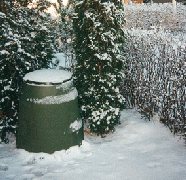
The Green Johanna
Winter Composter Jacket:
The optional Green Johanna Composter Winter Jacket
should be placed over the Green Johanna when the average outdoor
temperature consistently falls below 40°F, and removed when the
temperature is constantly above 50°F. It is essential that the winter
jacket is removed as the relative air temperature rises, otherwise the
compost will burn, in which event the microorganisms die and the
process is halted.
Green
Johanna Frequently Asked Questions:
-
Why
should I compost organic waste from the home?
A large
portion of garden waste and food scraps collected by municipal waste
companies ends up being disposed of in landfills or incinerated. If you
decide to compost you will be helping to reduce the amount of buried or
burned waste. Allowing organic wastes to break down in a composter is
more beneficial to the environment and to you. Landfills can produce
far more greenhouse gases when breaking down organic matter than a home
composter and with home composting you’ll end up with a usable material
to put back in your garden as a bonus for your efforts.
-
Why should I choose the
Green Johanna Composter?
The
Green Johanna
Composter is a superior
composter designed so that the contents are well ventilated, given free
drainage and kept in a protected environment during the breakdown
process. Its special conical shape helps prevent waste sticking to the
inside--leaving space for the air to move around. As long as you follow
the simple instructions, you should find the Green Johanna easy to use.
-
What is the Green Johanna
Composter made of?
The Green Johanna Composter is made of a
durable plastic that resists the elements including extreme
temperatures. It comes with a 5-year warranty.
-
How do you start?
Since
good air circulation is important to ensure efficient operation of your
Green Johanna Composter you will need to
place branches and twigs in a 4” to 8” layer inside at the base. Then,
add your garden and kitchen waste.
-
Can I place the Green Johanna Composter in direct sunlight?
No. The contents
should not be allowed to get too hot since this can kill off the
beneficial microbes breaking down the contents.
-
How much waste can it take?
It is
designed for a household with up to five people together with the
compostable waste produced from an average garden. However since this
is extremely variable, if you believe you are filling it too quickly it
would be recommended to have a second Green Johanna Composter. Remember a garden
produces less waste in winter. Some of the material in summer can be
kept to layer in with food waste during winter.
-
What are the dimensions of the Green Johanna
Composter?
The
Green Johanna Composter is 36 inches across
at the base, the lid is 21 inches wide and its overall height is 38
inches. It weighs approximately 22 lbs.
-
Why are there holes in the
base?
This
allows naturally occurring insects and worms to gain access to the
composter to aid in the breakdown process. It also lets excess moisture
out into the ground.
-
Where should you locate a Green Johanna
Composter?
Aim to
have the Green Johanna Composter as close to the
kitchen as possible, as you may want to put food waste in the composter
several times a week. The composter should stand on soil or grass, so
that the worms can get in through the holes in the base. A good place
is among trees, which give shade. The trees will also offer a certain
amount of protection from the cold in winter.
-
Why are the contents in the
composter warm during the composting process?
When the
microorganisms are actively breaking down waste, energy is released.
How warm the compost gets depends on what you have put in, together
with levels of oxygen and moisture.
-
Do I have to add any
chemicals to get started?
No.
Absolutely not! In fact chemicals
may upset the natural balance of the system.
-
Can I put my kitchen waste
directly in the compost without the branches and twigs first?
No. A good flow of air at
the base is essential for efficient operation of the Green Johanna Composter.
-
Can I mix garden waste and
kitchen waste?
Yes. It is recommended
that you put one part garden waste and two parts kitchen waste in to
help balance the carbon and nitrogen levels which will make better
compost more quickly.
-
Can I still use the
composter if I only have kitchen waste?
Yes.
If you add layers of sawdust (this will add carbon to balance
the nitrogen in the food waste).
-
What can I put in my
composter?
From the
kitchen: Fruit, vegetables,
dairy products, fish, shellfish, meat, bones, coffee grounds with
filter, teabags, eggshells, bread, sauce, soup, egg cartons and so on.
From the
garden: Grass, leaves,
twigs and branches.
-
What are rich in carbon?
Sawdust,
twigs, leaves and paper.
-
What are rich in nitrogen?
Eggs,
fish and meat. Newly cut grass also contains a lot of nitrogen.
-
What kind of paper from the
household can be thrown into the compost bin?
Unbleached
crepe paper, napkins, coffee filters, and torn egg cartons.
-
What should I do if I put a
lot of meat in the compost bin?
Put
sawdust on the top and close (but not entirely) the ventilation for a
few days, so flies can't get in.
-
What kind of material should
I spread over the kitchen waste?
Sawdust,
torn egg cartons, garden waste. (Carbon rich material).
-
What type of carbon rich
material should not be used in the compost?
Ashes,
lime and newspapers (due to the risk of lead in the ink).
-
What can't I put in my
composter?
Glass,
plastic, rubber, paint, chemicals, fabric, pet litter and so on.
-
Can I just throw everything
in the compost in no special order?
No.
You
should put material rich in carbon and material rich in nitrogen in
layers.
-
Should material be broken up
before being thrown into the compost?
Ideally
you should break up the material into small pieces, allowing the
microorganisms and worms to work more quickly.
-
If I don't put the material
in layers, what happens?
If you
mainly throw material rich in nitrogen in the compost, it will get too
wet and start to rot and smell. If you then on the other hand throw in
too much material rich in carbon the process will go very slowly or
stop.
-
How thick should the layers
of material be in my composter?
Not more
than 2 inches.
-
How much newly cut grass can
I put in my composter?
Avoid
large amounts of grass as this can prevent oxygen getting through and
slow or stop the process.
-
Can weeds grow in my
composter?
Generally
no, as they will be killed in the high temperatures
generated inside.
-
What does the compost smell
like?
There
should be little or no smell coming from a working composter that is
monitored for a properly layered mix of carbon rich and nitrogen rich
compostable materials.
-
Why does some compost smell
of ammonia?
If you
have too little material rich in carbon you will get a surplus of
nitrogen. This nitrogen turns into ammonia and gives off an odor.
If
your compost smells like ammonia, it is important that
air can get in to the compost. Mix the contents properly with a
stirring stick according to the instructions and add some material rich
in carbon.
-
Is it vital that I mix the
contents?
Yes.
The
microorganisms need oxygen to be able to work.
-
Can I put oak leaves in my
compost?
Yes,
but
they contain a high level of tannic acid and therefore it takes a long
time for them to compost into soil. In order to speed up the process
you should first put the oak leaves in a sealed (vacuum-sealed if
possible) plastic bag for a month or two before adding to the compost
pile.
-
Can I put moss in my
compost?
Only in
small amounts.
-
Can I put citrus peel in my
compost?
Yes you
can, but ideally break it up a little first and mix in with other food
or compost.
-
Can I put cat and dog litter
in my compost?
No. You should avoid
this, as it can be toxic.
-
If the composting process
has stopped, what can I do to restart it?
Empty
the contents out onto the ground. Add some water and mix in some
carbon-rich material. On the bottom of the composter layer branches and
twigs as before. Place the material back into the composter and start
over again.
-
If the contents start to rot
(go anaerobic) what can I do?
Add
sawdust, torn egg cartons or paper, as they will help to absorb excess
moisture.
-
What should I do if there
are a lot of flies in my compost?
Add
material rich in carbon, such as sawdust.
-
What
should I do if I have a lot of ants in my compost?
Ants are
a sign that the compost is too dry. Add water and stir with a stirring
stick.
-
How long will it take before
the contents are "ready"?
The first batch may
be ready in approximately six months, thereafter every three to four
months depending on many different factors.
-
How often should I empty my Green Johanna
Composter?
Twice a
year--spring and autumn. The Green Johanna Composter makes compost in as
little as every 4 to 6 months.
-
Can you use the composter
during the wintertime?
Yes, with the Green
Johanna Composter you can order the
optional winter jacket that protects against the cold and the wind. It
works to insulate the composter down to approximately -10°F. It is
recommended that the winter jacket be used when the temperature drops
below approximately 40 degrees.
-
How is the winter jacket
assembled?
Full
instructions come with the winter jacket and it is very simple to put
together. It is important that you add the winter jacket with the Green
Johanna Composter standing on its
base. If you do not, you may find it prevents the lid closing.
-
Can I leave the winter
jacket on during the summer?
No, you should remove
it when the temperature will no longer fall below 50 degrees. If you
leave it on, the Green Johanna Composter may overheat and
stop working correctly.
-
What should I do if the contents in the Green
Johanna Composter
have frozen?
Pour
warm water over the contents (around 100 degrees) together with some
further kitchen or garden waste to reintroduce microbes. If you know
that the compost was too wet when it froze, try without water, using
only the organic matter. An alternative method is to place a plastic
drink bottle containing boiled water into the compost. The warmth from
the hot water through the bottle will help to thaw the compost. Please
take extreme care when handling hot water.
Please allow approximately 1 to 2 weeks for delivery
|